Mosaic awarded NIH Phase I SBIR grant
A general-purpose microfluidic automation platform, with organoid perfusion as our first major application.
We’re proud to announce that Mosaic Design Labs has been awarded a Phase I Small Business Innovation Research (SBIR) grant from the National Institutes of Health to develop a general-purpose microfluidic automation platform. Our first product, the Mosaic MINI, pairs an electronic pressure controller with standard SBS plate-format consumables — giving researchers a versatile, affordable, automation-friendly system that runs on the benchtop under any standard inverted microscope, with nothing but a USB-C cable plugged in.
Why microfluidic automation, why now
Academic groups have demonstrated nearly every cell and molecular biology assay imaginable in microfluidics, but almost all of it has stayed in the demonstration phase. Working scientists rarely actually use these devices, especially anything involving pumps, valving, or bespoke automation. The commercial systems that do exist tend to be expensive, leak-prone, locked to a single cell type or assay, and difficult to integrate into broader lab workflows.
We see this as a platform problem, not an application problem. There’s no single “killer app” for microfluidic automation — it’s a horizontal technology that touches everything from 3D organoid culture and drug screening, to microbiology and microbial bioprocessing, to cell therapy production, to general molecular and cell biology assays. The tools that thrive will be the ones that give researchers maximum flexibility to bring their own creativity, across many application areas.
What we’re building
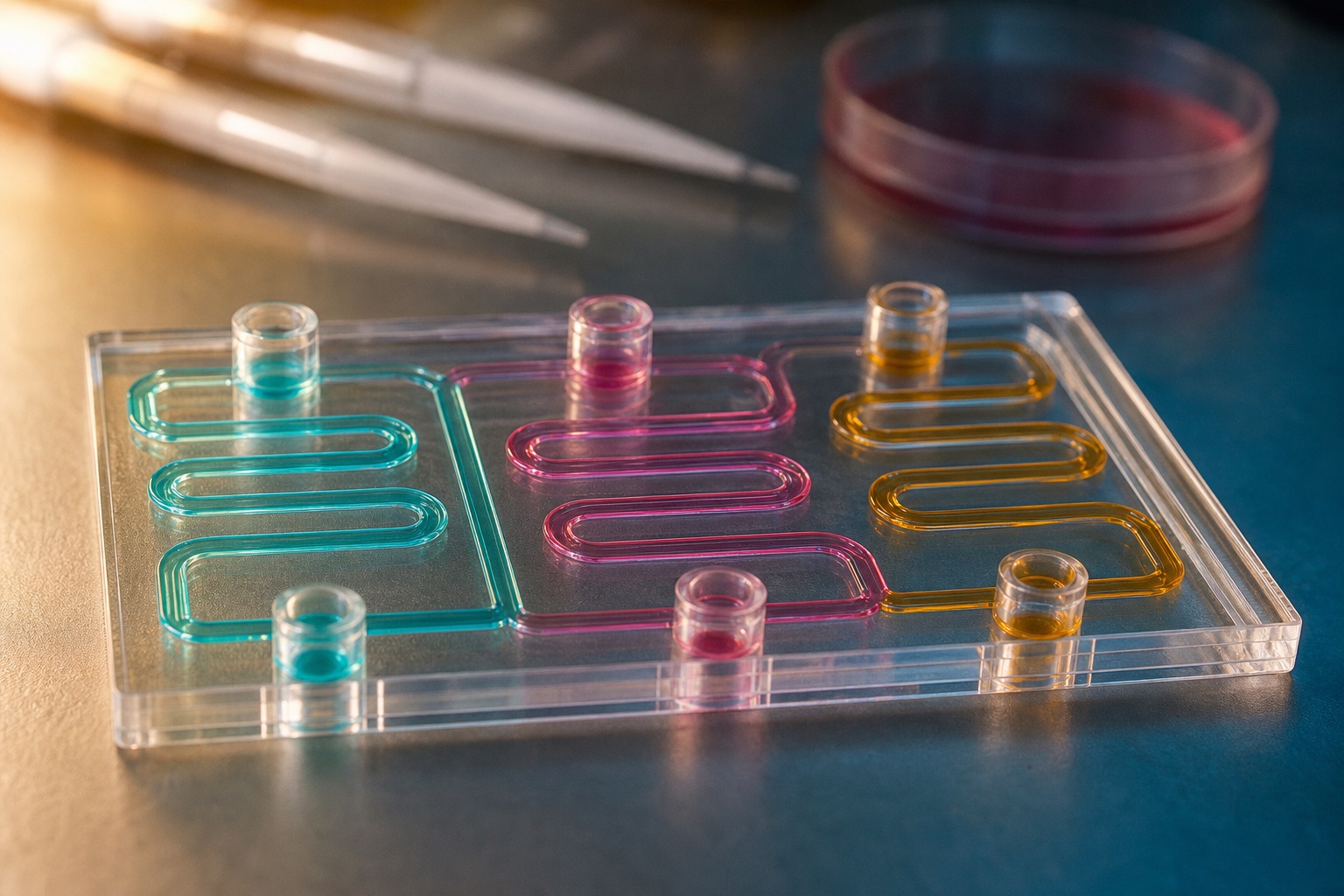
The Mosaic MINI eliminates the external pump and tubing harness entirely. A compact electronic pressure controller clamps directly to the top of a standard SBS plate, addressing pressure independently across dozens of on-plate reservoirs over a single USB-C connection. The result is a sterile, closed fluidic system with very few points of failure, small sample and reagent volumes, and a form factor that fits comfortably on any inverted microscope. Consumables are injection molded by our partners at Parallel Fluidics and Fathom, and our cloud-based scripting environment lets researchers define, version, and share protocols without installing anything locally — using the same controller and the same scripting language across any application they care to run.
What Phase I funds
The SBIR specifically funds a focused demonstration in 3D organoid perfusion — a major application area for the platform, and one with strong tailwinds from the 2022 FDA Modernization Act 2.0 and the broader industry shift toward alternatives to animal testing. Phase I has three goals: build and characterize the controller and software, demonstrate cardiac organoid differentiation under perfusion in collaboration with Bullseye Biotechnologies, and run a pharmacological dose-response experiment on those organoids to show that the platform can drive real drug-screening workflows. The differentiation work targets cardiac vascularized organoids from iPSCs — replacing a labor-intensive 16-day manual protocol with an automated one, and benchmarking viability, phenotype, and reagent consumption against the static benchtop method.
The team and collaborators
This work brings together Mosaic’s in-house team — Frankie Myers, PhD (founder; previously Director of Engineering at Lucira Health), Greg Meess (software; previously Sutro Machine and Autodesk), and Leo Saavedra (microfluidics) — with a strong external network. Our scientific collaborators include Oscar Abilez, MD, PhD at Bullseye Biotechnologies, who brings nearly two decades of experience in cardiovascular organoid development, and Peretz Partensky, PhD and Rui Tostoes, PhD at ImmuneBridge, who advise on requirements in cell therapy and bioprocess engineering.
What comes next
Phase I gets us to a working prototype, a validated control architecture, and biological proof points in the organoid space. Beyond that, we’ll broaden the consumable catalog to support other major application areas — microbial culture and bioprocessing, hepatocyte toxicity screening, tumor spheroid perfusion, suspension culture for immunotherapy production, and general cell and molecular biology. The longer-term vision is bigger still: a fully integrated instrument with automated imaging, a rack-mountable configuration that scales from R&D to cGMP production using the same plate format, and an online microfluidic CAD tool that lets researchers design and order their own consumables.
Our vision is an instrument as versatile as the microscope, with consumables as versatile and inexpensive as microwell plates.
Interested in learning more about our microfluidic automation platform or exploring collaboration opportunities? Contact our team today.