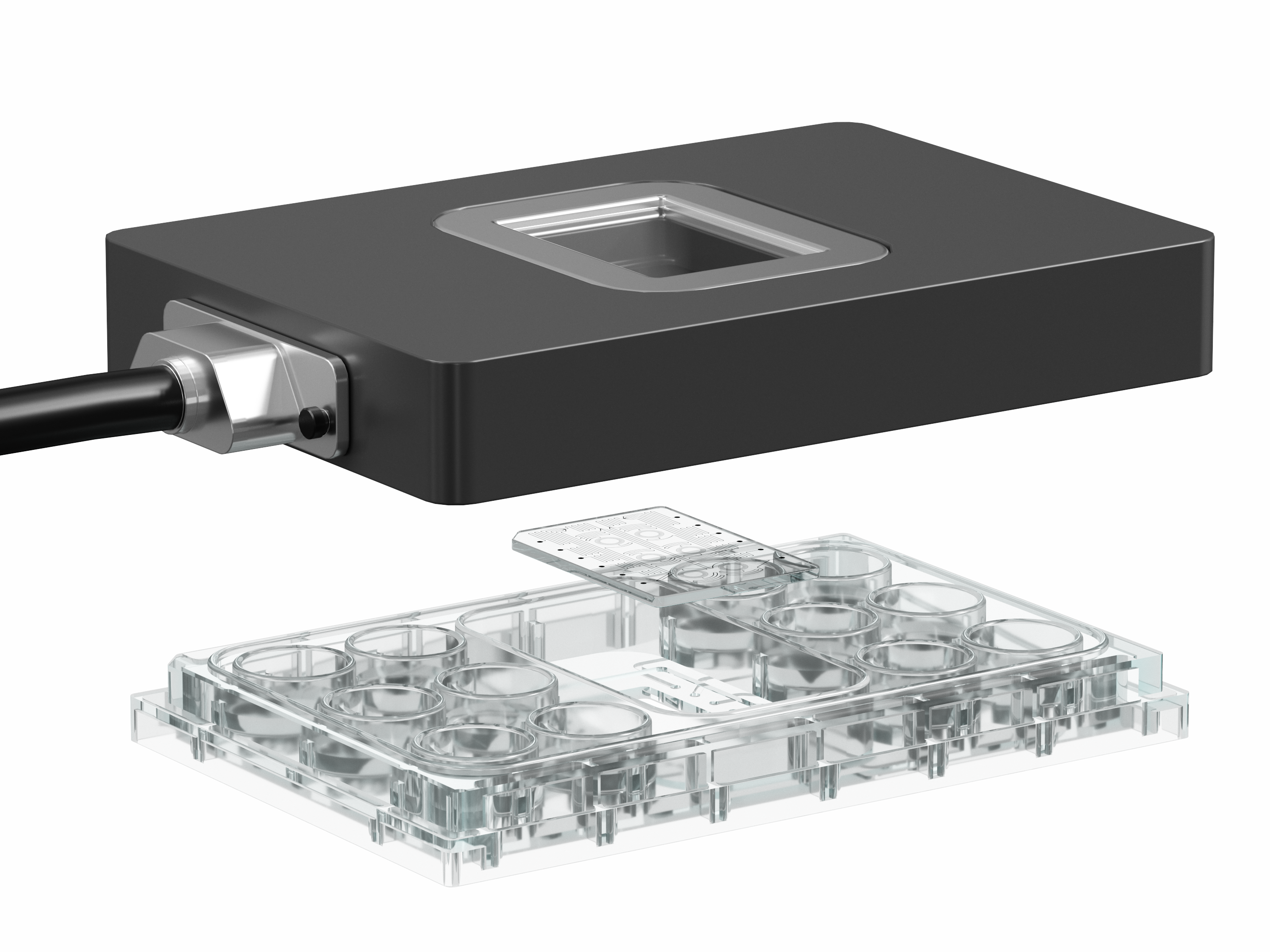
Case Study: Mosaic MicroLab

Internal R&D Platform

Universal Microfluidic Automation

Universal Microfluidic Automation

Key Metrics

Single-cell

Programmable workflows at single-cell resolution

Real-time

Integrated live-cell imaging and microfluidic control

Open

APIs for lab automation, LIMS, and AI pipelines

2 Apps

Initial focus: organoid perfusion and microbiology

Vision

Building the AI-driven laboratory of the future with programmable microfluidic automation.

The Challenge

Traditional lab automation excels at moving liquids between wells and tubes, but biology often demands more. Single cells behave differently than populations. Dynamic environments reveal biology that static conditions miss. Rare events require continuous observation.

The Vision

A programmable platform that brings industrial-grade microfluidic automation to any laboratory—combining precise fluid control, integrated imaging, and AI-native data architecture while extending (not replacing) existing liquid handlers and robotic systems.

Why Microfluidics Matters

Microfluidics manipulates fluids at picoliter to microliter scales with millisecond precision. Combined with real-time observation and adaptive control, it enables experiments that plate-based methods cannot run—tracking rare events, exposing cells to dynamic drug waveforms, and generating rich time-resolved datasets for machine learning.

The Mosaic MicroLab represents this convergence: microfluidics for biological manipulation, artificial intelligence for experimental design and analysis, and cloud computing for collaborative data science.

The MicroLab Platform

The Mosaic MicroLab is designed as a modular, open platform that complements existing lab automation infrastructure. Software-defined workflows enable researchers to design complex protocols—media exchanges, drug gradients, cell sorting, perfusion—and execute them autonomously with precise temporal control.

High-content imaging is built into the platform, not bolted on. Brightfield, phase contrast, and multi-channel fluorescence capture cellular dynamics while microfluidic operations control the environment. Open APIs enable integration with LIMS, automation platforms, and data pipelines; cartridges can be loaded by robots or by hand.

Development Status

The Mosaic MicroLab is in active development with proven core technologies from years of microfluidic design and instrumentation work, working prototypes demonstrating key capabilities, and established academic partnerships validating applications.

We are building toward prototype validation with early adopter labs, beta deployment with expanded imaging and AI integration, commercial launch with full automation integration, and an open ecosystem of third-party cartridges and community protocols.

Roadmap

Phase 2

Beta platform deployment with expanded imaging capabilities and AI integration

Phase 4

Ecosystem development—third-party cartridges, community protocols, and open-source tools

Phase 1

Prototype validation with early adopter labs in synthetic biology and microbiology (current)

Phase 3

Commercial launch with full automation integration and cloud infrastructure

Technology

A microfluidic platform designed for the automated lab

The MicroLab integrates programmable fluid control, live-cell imaging, and AI-native data architecture into a benchtop platform that scales from single-investigator studies to pharma screening.

Microfluidics + Traditional Automation

Liquid handlers excel at plate-based assays and high-throughput screening. Microfluidic platforms excel at dynamic experiments, single-cell precision, and continuous observation. The MicroLab is designed to work alongside both.

AI-Native Architecture

Structured, time-resolved datasets are designed for machine learning from the start. Real-time image analysis enables closed-loop experiments that adapt based on cellular responses, with cloud integration so models trained on one run inform the next.

Programmable Microfluidic Control

Software-defined workflows for media exchanges, drug gradients, cell sorting, and perfusion with precise temporal control.

Integrated Live-Cell Imaging

Brightfield, phase contrast, and multi-channel fluorescence built into the platform—not added as an afterthought.

AI-Native Data Architecture

Rich structured datasets for ML, real-time analysis, and closed-loop experimental adaptation.

Open Lab Integration

APIs for LIMS, automation platforms, and data pipelines; cartridges loadable by robots or by hand.

Mosaic MicroLab benchtop microfluidic automation platform with integrated imaging

Applications

Drug Discovery & Development

Challenge

Plate-based screens miss dynamic pharmacokinetics, morphological responses, and heterogeneity within organoid models.

Solution

Screen drug combinations in organoids or primary cells while capturing morphological and functional responses in real time, including complex PK waveforms under physiologically relevant conditions.

Synthetic Biology & Bioengineering

Challenge

Bulk assays average away single-cell heterogeneity and obscure lineage dynamics across conditions.

Solution

Characterize genetic circuits and biosensors at single-cell resolution across hundreds of conditions, tracking lineages to understand phenotypic heterogeneity and evolutionary dynamics.

Precision Medicine & Diagnostics

Challenge

Rare cell populations and resistant subpopulations are invisible to bulk antibiotic susceptibility assays.

Solution

Isolate and study rare cell populations from patient samples and perform rapid susceptibility testing that reveals resistant subpopulations.

Fundamental Biology

Challenge

Static plate conditions cannot capture signaling dynamics, cell-cell communication, or decision-making at relevant timescales.

Solution

Study cellular behavior with spatiotemporal resolution and run experiments impossible with traditional plate-based methods.

Integration & Foundation

Microfluidics and traditional automation working together—built on deep platform expertise.

Robotic Sample Loading

Liquid handlers prepare samples and load microfluidic cartridges, extending existing automation rather than replacing it.

Parallel Workflows

Run plate-based screens alongside microfluidic time-lapse experiments with results feeding unified analysis pipelines.

AI-Driven Orchestration

Machine learning models decide which samples warrant deeper microfluidic investigation based on upstream screening data.

Microfluidic Design

Decades of combined experience developing diagnostic and research microfluidic platforms inform every cartridge and control architecture decision.

Optical Engineering

High-content imaging systems purpose-built for biological applications, from diagnostics to live-cell dynamics.

Regulatory & Manufacturing

Experience bringing medical devices through FDA clearance and scaling from prototype to production informs platform development.

"Biology is entering a new era. The questions we can ask are limited not by our curiosity, but by our tools. The AI-driven laboratory will unlock them—but it requires infrastructure that generates the right data, in the right format, with the right level of control."

Mosaic Design Labs

Interested in the AI-driven lab of the future?

We are actively seeking research partners, strategic collaborators, and investors who share our vision. Whether you need single-cell precision for organoid perfusion, microbiology lineages, or next-generation screening—we would love to hear from you.

Explore Projects