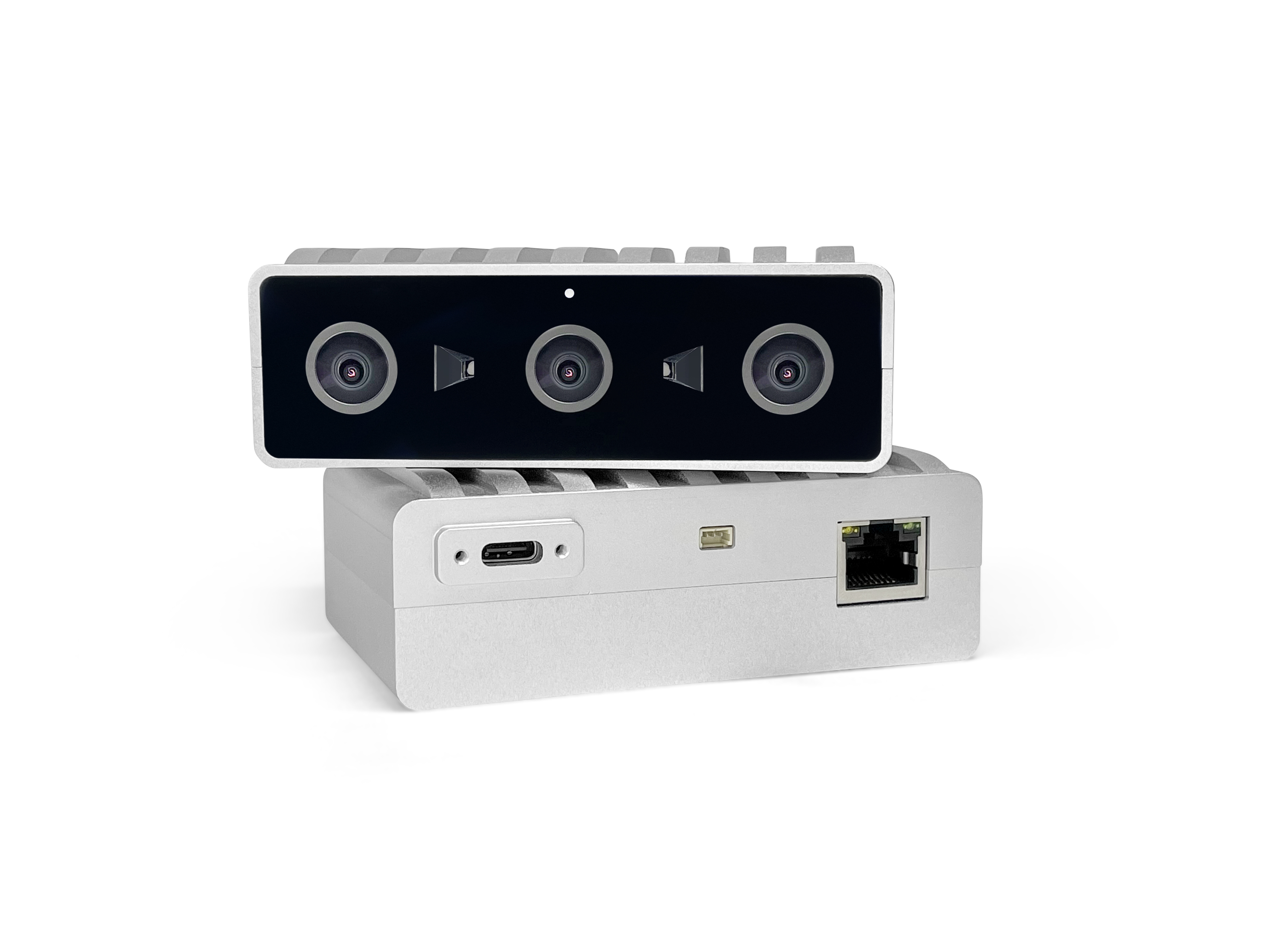
Project Overview
Tangram Vision approached Mosaic to develop the hardware for their next-generation 3D imaging device—a compact, AI-powered depth camera designed for industrial robotics, autonomous vehicles, and advanced machine vision applications. The challenge was to integrate cutting-edge computer vision algorithms with robust, production-ready hardware capable of real-time depth perception and on-device AI inference.
Mosaic led the complete hardware development, encompassing electrical engineering, optical design, mechanical engineering, and embedded Linux development. The result is a sophisticated imaging system that delivers professional-grade 3D perception in a form factor suitable for demanding industrial environments.
Technical Architecture
System-on-Chip: TI TDA4VM
At the heart of the system is the Texas Instruments TDA4VM, a heterogeneous SoC purpose-built for edge AI and vision processing:
- Dual Arm Cortex-A72 cores (2.0 GHz): High-performance application processing
- C7x DSP (1.0 GHz): 80 GFLOPS floating-point performance for signal processing
- Deep Learning Matrix Multiply Accelerator (MMA): 8 TOPS (INT8) for neural network inference
- Vision Processing Accelerators (VPAC): Dedicated ISP and vision assist accelerators
- Depth and Motion Processing Accelerators (DMPAC): Hardware-accelerated stereo matching and optical flow
This architecture enables the device to perform real-time stereo depth computation, AI inference, and sensor fusion entirely on-device, eliminating the need for external compute resources.
Optical System Design
The imaging system incorporates a multi-modal sensor suite optimized for robust depth perception across diverse lighting conditions:
Stereo Vision Subsystem
- Precision-matched pair of monochrome global shutter cameras
- Optimized baseline and focal length for target depth range
- Synchronized capture with sub-microsecond precision
- Hardware-accelerated stereo correspondence algorithms
Structured Light Subsystem
- Dual infrared dot projectors for active illumination
- Pseudorandom pattern optimized for feature-rich correspondence
- Enhances depth accuracy in textureless environments
- Synchronized with stereo capture for hybrid depth estimation
RGB Imaging
- High-resolution color camera for texture mapping and visual odometry
- Calibrated to stereo baseline for registered RGB-D output
- Supports AI-based semantic segmentation and object detection
The optical design required careful attention to:
- Lens selection and mounting: Minimizing distortion while maintaining compact form factor
- Calibration stability: Mechanical design ensuring long-term calibration retention
- Optical isolation: Preventing crosstalk between IR projectors and cameras
- Thermal compensation: Accounting for focus shift across operating temperature range
Electrical Engineering
The electrical design presented significant challenges in power, thermal, and signal integrity:
14-Layer PCB Architecture
- High-speed differential routing: MIPI CSI-2 lanes, USB 3.0, Gigabit Ethernet
- Power delivery network: Multiple voltage rails with tight regulation requirements
- Impedance-controlled stackup: Maintaining signal integrity across dense routing
- Thermal vias and copper pours: Integrated heat spreading for fanless operation
Power Management
- Dual power input options: USB-C (5V/3A) or Power over Ethernet (IEEE 802.3af)
- Efficient DC-DC converters with >90% efficiency
- Dynamic voltage and frequency scaling (DVFS) for power optimization
- Total system power budget: 15W under full computational load
Sensor Interfaces
- Multiple MIPI CSI-2 camera interfaces with precise clock distribution
- I²C bus architecture for sensor configuration and monitoring
- GPIO control for synchronized capture and illumination
- Hardware timestamping for sensor fusion
Mechanical Design & Thermal Management
The mechanical enclosure balances compactness, durability, and thermal performance:
Thermal Architecture
- Direct thermal coupling from TDA4VM to aluminum chassis
- Optimized fin geometry for natural convection cooling
- Thermal interface materials selected for long-term reliability
- Maintains junction temperature <85°C at 15W dissipation in 40°C ambient
Structural Design
- Precision-machined aluminum housing for dimensional stability
- Integrated mounting interfaces for robotic and vehicle integration
- Sealed design with IP54 rating for dust and splash protection
- Vibration-resistant camera mounting to maintain calibration
Design for Manufacturing
- Modular assembly enabling efficient production and testing
- Standardized fasteners and connectors for serviceability
- Designed for automated optical calibration during manufacturing
Embedded Software Development
Mosaic developed a custom Linux distribution tailored to the hardware platform:
Yocto Linux Build System
- Custom board support package (BSP) for TDA4VM
- Optimized kernel configuration for real-time performance
- Integration of TI’s edge AI software stack
- Minimal rootfs for fast boot times (<10 seconds)
Kernel Development
- Camera drivers: V4L2 drivers for all imaging sensors with synchronized capture
- Device tree overlays: Hardware configuration for flexible deployment
- Power management: Integration with TDA4VM DVFS and thermal management
- Network stack optimization: Low-latency streaming for remote visualization
Collaboration with Tangram Vision
Worked closely with Tangram’s software team to ensure seamless integration of their computer vision algorithms:
- Defined hardware abstraction layers for sensor access
- Optimized memory allocation for zero-copy image pipelines
- Validated AI model performance on MMA accelerator
- Developed calibration and testing tools
Development Challenges
High-Speed Signal Integrity
Routing multiple MIPI CSI-2 interfaces on a compact PCB required careful impedance control, differential pair matching, and EMI mitigation. We employed 3D electromagnetic simulation to optimize the stackup and validate signal integrity before fabrication.
Thermal Management Without Active Cooling
Achieving 15W passive cooling in a compact form factor demanded iterative thermal simulation and testing. We optimized the chassis geometry, thermal interface materials, and component placement to maximize heat spreading while maintaining a small footprint.
Multi-Camera Synchronization
Precise temporal alignment of stereo cameras and structured light projectors is critical for accurate depth reconstruction. We implemented hardware-triggered capture with sub-microsecond synchronization and validated timing across temperature and voltage variations.
Optical Calibration Stability
Maintaining factory calibration over the product lifetime required mechanical design that minimizes stress on camera mounts due to thermal expansion, vibration, and handling. We validated calibration stability through accelerated life testing.
Power Budget Optimization
Meeting the 15W power budget while running AI inference and multi-camera capture required aggressive power optimization:
- Dynamic clock gating and voltage scaling
- Efficient DC-DC converter selection
- Minimizing I/O power through careful interface selection
- Firmware-level power state management
Go-to-Market Support
Beyond hardware development, Mosaic contributed to Tangram’s commercialization efforts:
Kickstarter Campaign
- Developed compelling product photography and technical illustrations
- Created exploded-view diagrams showing internal architecture
- Contributed to technical specifications and marketing copy
- Provided engineering support during campaign Q&A
Manufacturing Partnerships
- Identified and qualified contract manufacturers for PCB assembly
- Established relationships with optical assembly and calibration vendors
- Developed manufacturing test procedures and fixtures
- Supported first article inspection and production ramp
Packaging Design
- Designed retail-ready packaging balancing protection and presentation
- Developed quick-start guides and technical documentation
- Created accessory ecosystem (mounts, cables, calibration targets)
Technical Specifications
Imaging Performance
- Depth range: 0.3m to 10m (structured light), 0.5m to 20m (stereo)
- Depth accuracy: <1% at 1m distance
- Depth resolution: VGA (640×480) at 30 fps
- RGB resolution: 1920×1080 at 30 fps
- Field of view: 90° horizontal (configurable with lens options)
Computational Performance
- AI inference: 8 TOPS (INT8), 2 TFLOPS (FP32)
- Stereo processing: Hardware-accelerated, <10ms latency
- Power consumption: 8W typical, 15W maximum
Physical & Environmental
- Dimensions: 120mm × 40mm × 35mm
- Weight: 250g
- Operating temperature: -10°C to 50°C
- Storage temperature: -20°C to 70°C
- Ingress protection: IP54
Connectivity
- USB 3.1 Gen 1 (5 Gbps) with USB-C connector
- Gigabit Ethernet with PoE support (IEEE 802.3af)
- GPIO expansion for external triggers and synchronization
Impact & Recognition
The Tangram Vision 3D camera successfully launched on Kickstarter, exceeding funding goals and validating market demand for accessible, high-performance depth sensing. The platform has been adopted by:
- Industrial robotics: Bin picking, palletizing, and quality inspection
- Autonomous vehicles: Obstacle detection and path planning
- Research institutions: Computer vision and robotics research
- Drone manufacturers: Collision avoidance and terrain mapping
The project demonstrates Mosaic’s ability to deliver complete hardware solutions for cutting-edge AI and computer vision applications—from concept through production.
Lessons Learned
Heterogeneous Computing Architecture
Modern edge AI applications demand specialized accelerators. Understanding the capabilities and limitations of different compute units (CPU, DSP, AI accelerator) is essential for system architecture and software optimization.
Thermal-First Design
For fanless systems, thermal management cannot be an afterthought. Early thermal simulation and prototype testing are critical to avoid costly redesigns.
Co-Design with Software
Hardware and software must be developed in parallel, with continuous integration and testing. Close collaboration with the software team ensured optimal utilization of hardware capabilities.
Manufacturing Readiness
Designing for manufacturing from day one—considering assembly processes, test procedures, and supply chain—accelerates time to market and reduces production costs.
The Tangram Vision project showcases Mosaic’s comprehensive engineering capabilities and our commitment to delivering production-ready hardware that enables breakthrough AI and computer vision applications.
Interested in developing advanced imaging systems or edge AI hardware? Contact us to discuss how we can bring your vision to life.